Back to Basics, Ahead in Privacy:
Like many modern training providers, Australian Lifesaver Training once embraced student apps. Initially, these apps helped streamline course check-ins and daily administration. However, the digital landscape is changing fast. After weighing the risks, the organisation made a deliberate business decision. In today’s cybersecurity climate, the risk to student privacy is simply too high.
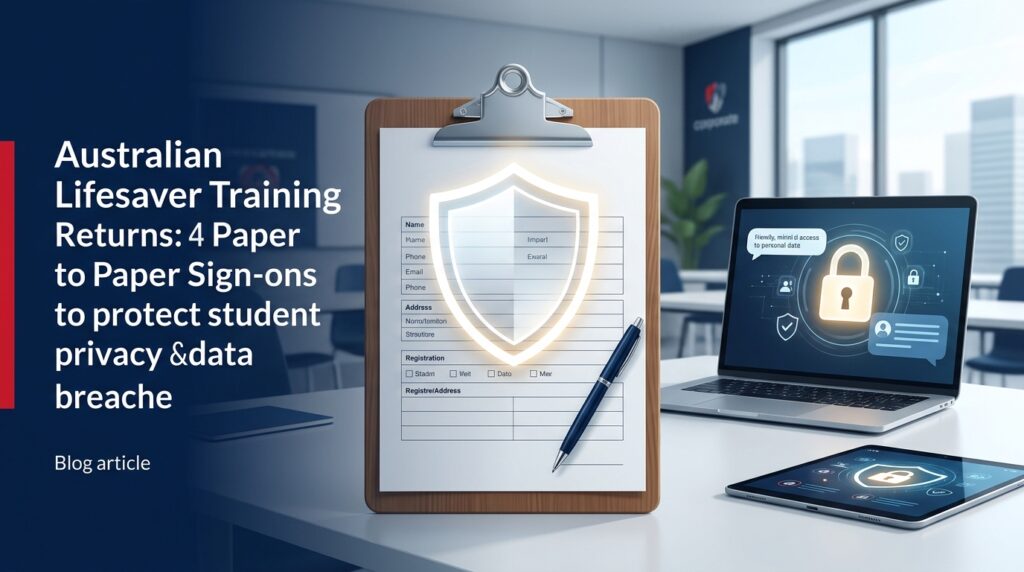
Therefore, rather than asking participants to download apps, Australian Lifesaver Training paper sign-ons are making a refreshing return. Some might see this as a step back in time. In reality, this practical shift is a major leap forward for member safety. Consequently, keeping attendance and personal details off cloud databases protects the community from cyberattacks.
Protecting What Matters Most With Paper Sign-Ons
Across Australia, high-profile data breaches have made people cautious about sharing personal details. Indeed, that caution is well-founded. According to the Office of the Australian Information Commissioner (OAIC), data breach notifications recently reached record highs. Furthermore, malicious cyber incidents make up the vast majority of these attacks. Every new app on a smartphone creates another digital footprint and potential vulnerability.
To combat these risks, the Australian Cyber Security Centre (ACSC) advises strict data minimisation. Essentially, this means collecting only the personal data strictly necessary to operate.
Stepping away from student apps in favour of Australian Lifesaver Training paper sign-ons puts this federal advice into action. As a result, participants’ private details stay safely managed in the real world. Moreover, they remain well out of the reach of online hackers. For students and families, it also means less screen time.
Additionally, no forgotten passwords on the beach or poolside means a hassle-free start to training.
Smart Tech and Strict AI Boundaries
Deciding that sign-on apps carry too much risk does not mean rejecting helpful technology. Instead, Australian Lifesaver Training is being smart and selective about digital tools.
To support participants and answer inquiries quickly, the organisation introduced a dedicated Artificial Intelligence (AI) system. Crucially, this AI has strict privacy guardrails. Specifically, it is completely blocked from accessing any student data.
This approach aligns directly with the Australian Government’s Guidance for AI Adoption. That framework emphasises strong data governance and preventing AI from exposing sensitive details. Similarly, the OAIC’s guidance on AI and privacy highlights the need for transparency. Furthermore, it urges organisations to limit personal information inputs into AI tools.
The Australian Lifesaver Training AI does not store or process personal records. Instead, it operates purely as an advanced answering service. For instance, someone might need to know what to bring to their training. Likewise, they may want to check course prerequisites or ask general water safety questions. Accordingly, the AI provides instant, reliable answers around the clock. Best of all, it helps without ever needing to know who is asking.
Meanwhile, a dedicated Australian Lifesaver Training team member handles any tasks involving personal records, billing, or enrolment changes. As a result, sensitive requests receive personal, secure human attention rather than automated processing.
Human Support Where It Counts for Students
Because the system has zero access to personal accounts or financial records, it has clear boundaries. Specifically, the AI cannot take payments, retrieve certificates, or change participants to a new class date for a public course.
Meanwhile, a dedicated Australian Lifesaver Training team member handles any tasks involving personal records, billing, or enrolment changes. As a result, sensitive requests receive personal, secure human attention rather than automated processing.
The Best of Both Worlds
Ultimately, this balanced approach highlights a growing trend among trusted Australian organisations. Teams use modern technology where it safely adds value. At the same time, they rely on proven, low-risk methods to safeguard privacy.
In summary, Australian Lifesaver Training pairs a strictly sandboxed AI helper with the security of Australian Lifesaver Training paper sign-ons. By doing so, they prove that community protection goes beyond the flags. Indeed, it extends to personal information, too.
Credible References & Further Reading
- Data Breach Statistics: OAIC Notifiable Data Breaches Report – Official reporting on data breaches affecting Australians.
- Data Minimisation Advice: ACSC Protecting Business & Customer Data – Guidance on limiting digital data collection.
- Consumer Breach Prevention: ACSC Learn About Data Breaches – Government advice on sharing personal information safely.
- Safe AI Governance: Australian Government Guidance for AI Adoption – National framework for safe AI practices.
- AI & Privacy Compliance: OAIC Guidance on Privacy and AI – Regulatory advice on keeping personal data out of AI tools.